 Català (Catalan)
  Español (Spanish)
There’s no doubt in my mind that artificial intelligence is a godsend for teachers. If you’ve taken the time to learn a bit about how it works, which is nothing magical, its limitations, errors, and biases, as well as the ethics of its use, you already have a solid foundation for using it critically and effectively. If, on top of that, you’ve spent a few hours interacting with it and have training in pedagogy and curriculum design (which, if you’re a teacher, you should have), it becomes a fantastic tool to help you (yes, I said help you, not do the work for you) set learning objectives, define assessment criteria, and plan activities. It will also be very useful for creating resources, scaffolding, and assessment tools, as well as for making adaptations for students with diverse characteristics or functional diversity.
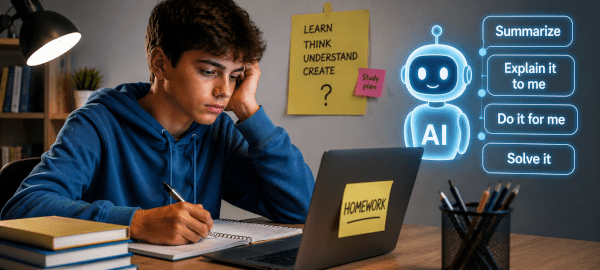
But when we talk about students’ use of it, things change. There’s a lot that could be said, but in this article I’d like to focus on just one specific point: homework.
Let me state two premises that are clear to me. If you don’t agree, no problem, you don’t need to read any further.
- Whether we like it or not, students will use artificial intelligence outside the classroom to complete schoolwork. We can create all the guidelines we want and offer whatever recommendations we deem best, but a significant number of teenagers will follow the path of least resistance and use AI to do their work for them.
- In middle school, homework—when it is creative, motivating, and of moderate length (and therefore not monotonous or repetitive)—improves student learning. In this regard, research is beginning to play a significant role, although more research is still needed. John Hattie’s famous study already pointed in that direction. But so do others, such as the compilation of evidence by the Education Endowment Fundation.
Personally, I’m not at all concerned about using AI in the classroom. I’m sure there are teachers who are concerned, and they must have their reasons, which I respect deeply. But I’ve never had a problem with digital technology in the classroom. The students are very clear that there are times when we open our computers and use them, and there are many times when we close them and interact orally or in writing.
In my classes (I haven’t taught for a little over a year now, as my professional life has taken me down other paths), it was very common to open and close computers. We might do it three or four times in a single class. And I would always walk around or stand at the back to check what was going on.
So, maybe they were fooling me very well, but I don’t think it was a problem in the classroom. And this doesn’t mean AI wasn’t present. I’m certain we must encourage them to learn how to use it. Most won’t learn on their own. How to interact with it, how to verify answers, when it’s useful for reviewing assignments and identifying areas for improvement, etc. Basically, a bit like what we were already doing with source verification, fake news detection, digital identity, and digital well-being, etc.
So far, so good. But when it comes to homework, I have to admit I wouldn’t know how to handle it. It’s hard to say, but does assigning homework even make sense anymore? Three students already said it a few months ago on RAC1 radio: “Doing homework at home is an outdated idea.”
Years ago, we learned to assign homework that couldn’t be found directly on the internet. We used Bloom’s taxonomy, and the assignments were designed to analyze, compare, elaborate, design, evaluate, solve problems, etc., or, to put it simply, to summarize or create outlines. Perhaps there were some students who didn’t do it themselves and whose families occasionally did the work for them, but usually, those who did (which is another issue) did it themselves (with more or less help depending on their capabilities and needs).
But AI is changing all of this as well. All these verbs from Bloom’s taxonomy that I’ve mentioned—and many others—are performed by AI, and it does them very well. Therefore, to complete homework without delegating cognitive tasks to AI requires a very strong will, which is not typically common among teenagers. There are some, of course! In my training sessions, I always gave the example of that high school sophomore who told me he’d been given an iPad for his 18th birthday on a Thursday, and didn’t open it until the following Tuesday because he had final exams and needed to study over the weekend. There are some with that level of responsibility and willpower, but they’re very few.
So, if we combine this factor introduced by AI with the two initial premises, what should we do? Should we stop assigning homework? It’s a simple solution. In fact, homework is certainly a source of inequality, since some students have a lot of support while others have none. But keep in mind that the Education Endowment Foundation has determined that homework is equivalent to a 5-month academic gain per school year. In other words, there is 50% more learning. Given our current curricula and the results of international tests (which measure what they measure, as we know, but serve as an indicator), can we afford to give up this learning? Can students afford to give it up? And mind you, I’ve never been a fan of assigning a lot of homework. As I said at the beginning, the assignments I gave were creative, motivating, and of moderate length.
Some people include the research project that Catalan high school seniors complete as part of the same package. For me, that’s a different case. If the process of creating the project is clearly defined, and students have a set process to follow—with different milestones (not regarding the content of the project, but the stages of research)—I don’t think learning suffers as a result. The goal of the project is to learn the process of conducting research, not to produce a well-written report on a specific topic. But, well, that would be another article, and there’s no need to get into a debate right now. In fact, maybe someday I’ll have time to explain and publish an app I’ve collaborated on with a high school in Sabadell to track this research project.
Anyway, I’ll wrap this up, as I often do, without any solutions. AI is welcome among teachers and welcome at times for students if we guide them in how to use it (provided we’ve learned how ourselves first). But let’s see how we make up for what we used to do with homework, which now only a few will tackle with cognitive effort.
Oh! And to write this article, no, I didn’t use AI (though there wouldn’t be any problem if I had). Just for the cover image.
